Move from CRM complexity to a platform your teams can actually use.
Salesforce may have helped you get where you are today, but growing complexity can make your CRM harder to manage. We help you migrate to HubSpot while preserving the data, processes, integrations, and business logic that matter.
Your CRM should accelerate growth.
Not slow it down.
Salesforce is built for extensive customization. But over time, flexibility can become operational complexity.
Does any of this sound familiar?
Every change requires help
New fields, automations, reports, or processes depend on administrators, developers, or external consultants.
Your teams work around the CRM
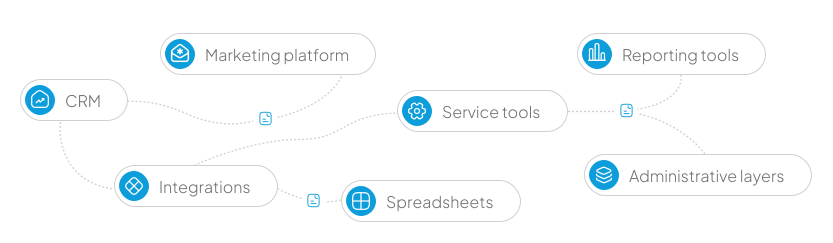
Sales reps avoid updating records. Marketing maintains separate systems. Operations relies on spreadsheets.
Reporting is harder than it should be
Getting one reliable view of pipeline, marketing, sales, and customer activity requires manual reconciliation.
Your architecture has become technical debt
Years of custom objects, integrations, automations, and fields make changes increasingly risky.
Adoption never really happened
People know enough Salesforce to complete required tasks — but not enough to use it as a growth platform.
AI means adding even more complexity
Instead of simplifying operations, new tools and AI initiatives add another layer to an already fragmented stack.
Maybe the problem isn't your people.
Maybe it's the architecture they're being asked to work around.
What if your CRM were easier to run?
Moving to HubSpot is not simply about replacing Salesforce.
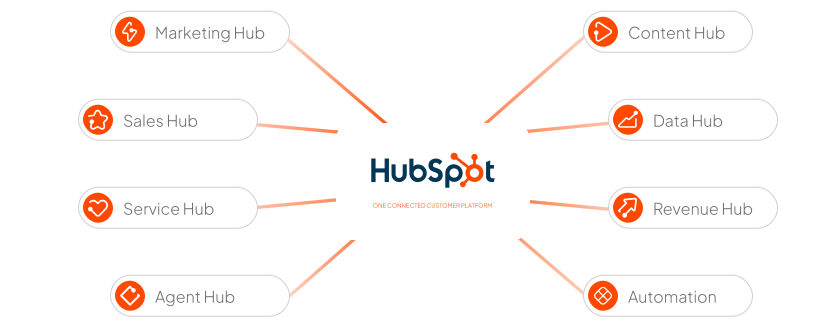
It is an opportunity to rethink how marketing, sales, service, data, automation, and AI work together.
Instead of recreating years of CRM complexity, you can build a cleaner operating model around one connected customer platform.
Before
After
One connected customer platform
All working from shared customer context.
Salesforce vs. HubSpot
Both platforms can support sophisticated organizations. The difference is often in how much operational complexity your company wants to manage.
| Capability |
|
|
|---|---|---|
| One connected customer platform | ||
| Marketing, sales, and service on the same CRM | ||
| Day-to-day changes without heavy technical dependency | ||
| Visual automation for business teams | ||
| Unified reporting across customer-facing teams | ||
| AI capabilities embedded across the platform | ||
| Supports complex enterprise CRM architectures |
Capability
-
One connected customer platform
-
Marketing, sales, and service on the same CRM
-
Day-to-day changes without heavy technical dependency
-
Visual automation for business teams
-
Unified reporting across customer-facing teams
-
AI capabilities embedded across the platform
-
Supports complex enterprise CRM architectures
Salesforce offers deep flexibility.
HubSpot offers many of the capabilities growing teams need with a more connected and easier-to-manage operating model.
The goal is not to recreate Salesforce inside HubSpot.
-
Some processes should migrate.
-
Some should be redesigned.
-
Some should disappear completely.
A successful migration preserves the business logic you need without carrying unnecessary technical debt into the new platform.
Moving data is easy.
Moving the business behind the data is the real migration.
A Salesforce environment represents years of decisions about how your company generates demand, sells, serves customers, reports performance, and manages information.
“Which fields do you want us to copy?”
-
How your business generates demand
-
How your sales process works
-
How teams manage customers
-
Which data actually matters
-
Which integrations are critical
-
Which processes should survive the migration
-
Which processes should be redesigned
How we migrate from Salesforce to HubSpot
01 Discovery
We assess your Salesforce environment, processes, data, integrations, reporting, and permissions.Outcome: A clear picture of what exists today.
02 Architecture
We design the future-state HubSpot structure, including objects, properties, pipelines, automation, reporting, and governance.Outcome: A blueprint for the new CRM.
03 Data Preparation & Migration
We clean, map, transform, and migrate the records that matter.Outcome: Cleaner data in a cleaner CRM.
04 Build, Integration & Validation
We configure HubSpot, connect critical systems, and validate workflows, permissions, reporting, and key processes.Outcome: A platform ready for go-live.
05 Enablement
We prepare your teams to work confidently in the new CRM.Outcome: Adoption, not just implementation.
What can move to HubSpot?
CRM Data
Contacts, companies, accounts, leads, opportunities, deals, and owners.
Historical Data
Activities, interactions, sales history, and critical legacy records.
Business Logic
Lifecycle stages, qualification, routing, pipelines, and workflows.
Custom Data
Custom properties, objects, associations, and industry-specific structures.
Reporting
KPIs, dashboards, pipeline, revenue, and marketing reporting.
Integrations
ERP, EHR, billing, data warehouses, communication tools, and other critical systems.

The objective is a better architecture for the next stage of your business.
Your CRM architecture should reflect your industry.
The platform can be the same. The operating model isn't.
-
Financial Services
Banks · Credit Unions · Fintech · Financial InstitutionsFinancial organizations need CRM architecture capable of connecting complex customer relationships, acquisition, service teams, governance, reporting, and legacy systems.
A Salesforce-to-HubSpot migration can simplify the operating model while preserving the controls and integrations the business requires.
Common considerations
- Data governance
- Complex relationships
- Customer lifecycle
- Legacy integrations
- Lead management
- Compliance
- Reporting
-
Healthcare
Providers · Health Systems · Multi-site Healthcare · HealthtechHealthcare organizations need to coordinate acquisition, patient engagement, referral relationships, multiple locations, and service operations.
Sparkon designs HubSpot environments with the appropriate data architecture, permissions, integrations, and governance in mind.
Common considerations
- HIPAA-aware architecture
- EHR integrations
- Patient journeys
- Referral management
- Multiple locations
- Permissions
- Data governance
-
Construction
Construction · Contractors · Developers · Building ServicesConstruction companies often manage complex networks of prospects, projects, contractors, subcontractors, partners, and locations.
A cleaner CRM can help teams understand every relationship and opportunity without navigating unnecessary complexity.
Common considerations
- Long sales cycles
- Account relationships
- Project pipelines
- Multiple stakeholders
- Locations
- Sales forecasting
-
Manufacturing
Manufacturers · Industrial companies · Distribution networksManufacturing businesses often combine direct sales, distribution, territories, partners, product lines, and ERP data.
The right HubSpot architecture can connect those relationships while keeping the CRM usable for commercial teams.
Common considerations
- ERP integration
- Distributors
- Partners
- Territories
- Product lines
- Long buying cycles
- Complex accounts