
 About Us


.webp?width=725&name=IMAGENES%20DESTACADAS%20-%20BLOGS%20(1080%20x%201080%20px).webp)
6 Best AI-First HubSpot Partners in the U.S. for 2026


Last reviewed: September 30, 2026
Choosing a HubSpot partner in 2026 is no longer only about certifications, onboarding, migrations, and workflows.
For B2B companies planning to use AI across marketing, sales, service, and revenue operations, another question matters: can the partner design the CRM, data, integrations, and operating processes that those AI use cases depend on?
HubSpot itself increasingly connects AI readiness with the quality and structure of CRM data. Its AI and automation capabilities can use CRM properties, activity, associations, and buying signals to support use cases such as scoring, prospecting, research, and workflow automation.
That makes the underlying operating system important. Inconsistent lifecycle definitions, fragmented customer records, missing associations, poorly governed properties, or unmanaged integrations can limit the context available to the people, workflows, and AI tools using the CRM.
For this article, we reviewed six U.S.-relevant HubSpot partners with public evidence across AI, RevOps, CRM and data architecture, integrations, governance, and ongoing operations.
Quick guide: 6 AI-first HubSpot partners to evaluate in 2026
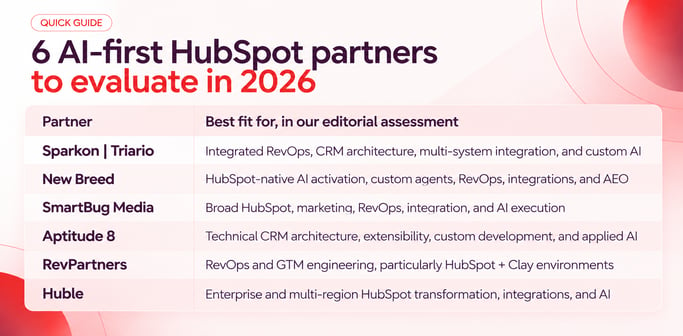
The order above is not a numerical performance ranking. The right fit depends on your systems, operating model, AI use cases, internal capabilities, and implementation complexity.
What “best” and “AI-first” mean in this article
“Best” refers to an evidence-based editorial shortlist for the use cases described below. It is not an official HubSpot ranking and does not mean one company is universally better than every alternative.
Likewise, AI-first is not an official HubSpot partner designation.
We use it as an editorial framework for partners that demonstrate public capability across several areas required to put AI into practical revenue operations:
- AI agents or AI-enabled workflows
- CRM and data architecture
- RevOps and cross-functional process design
- Data governance
- Multi-system integrations
- Ongoing optimization and operational support
Having an AI landing page alone is not enough.
Why AI readiness matters in a HubSpot implementation
An AI-ready HubSpot environment does not mean automating every process or deploying an agent everywhere. It means creating an environment where appropriate AI use cases can operate on clearly defined data, processes, ownership, and integrations.
AI readiness starts with the system behind the AI, not the AI tool itself.
Consider three common areas:
Data quality and customer context
Duplicate or fragmented records can separate activities, associations, and property information that would otherwise contribute to a more coherent CRM record.
That does not mean duplicates affect HubSpot's predictive scoring through a known mathematical mechanism. HubSpot describes its predictive models as machine-learning systems whose individual input contributions are not necessarily visible.
The more defensible takeaway is simpler: fragmented CRM data can create fragmented operational context.
Object associations
Contacts, companies, deals, tickets, and custom objects often contain different parts of the context a workflow or AI use case needs.
HubSpot's current automation and agent capabilities can retrieve and use associated records. When relevant associations are missing or incorrect, a workflow or agent may have less context available for the task it is configured to perform.
AI can only work with the context your CRM and connected systems make available.
Lifecycle and process governance
If Marketing, Sales, and Customer Success use different definitions for lifecycle stages, ownership, qualification, or handoffs, adding automation does not resolve that ambiguity automatically. AI and automation can operationalize processes, but the underlying rules still need to be understood and governed.
Forrester's 2026 research on agentic AI points in the same general direction: organizations need data, business context, governance, trust, and traceability to scale agent-based systems responsibly.
Find our more: AI-ready HubSpot environment
How we chose the six AI-first HubSpot partners
We evaluated each company against five practical dimensions using public evidence available as of September 30, 2026.
1. AI and agent capability
Does the partner publicly document work involving HubSpot AI, custom agents, external AI systems, AI-enabled workflows, or AI implementation services?
2. RevOps depth
Does the partner work across Marketing, Sales, and Service or Customer Success, or is its public positioning primarily limited to isolated HubSpot configuration?
3. Integration and data architecture
Is there evidence of custom APIs, middleware, ERP connections, data warehouses, custom data models, complex migrations, or other multi-system work?
4. Governance and operational design
Does the methodology include discovery, CRM auditing, current-state mapping, data governance, permissions, lifecycle design, or process architecture?
5. Ongoing support
Is there a documented way to operate, monitor, maintain, or continuously improve the environment after launch?
An AI-first partner is defined by how AI connects to data, processes, governance, and operations.
A capability listed on a partner's own website establishes that it is a documented offering. It does not independently prove delivery quality, customer outcomes, or depth in every possible use case.
Similarly, when we did not identify public evidence for a capability, we did not interpret that absence as proof that the company cannot provide it.
Comparison: AI-first HubSpot partners at a glance
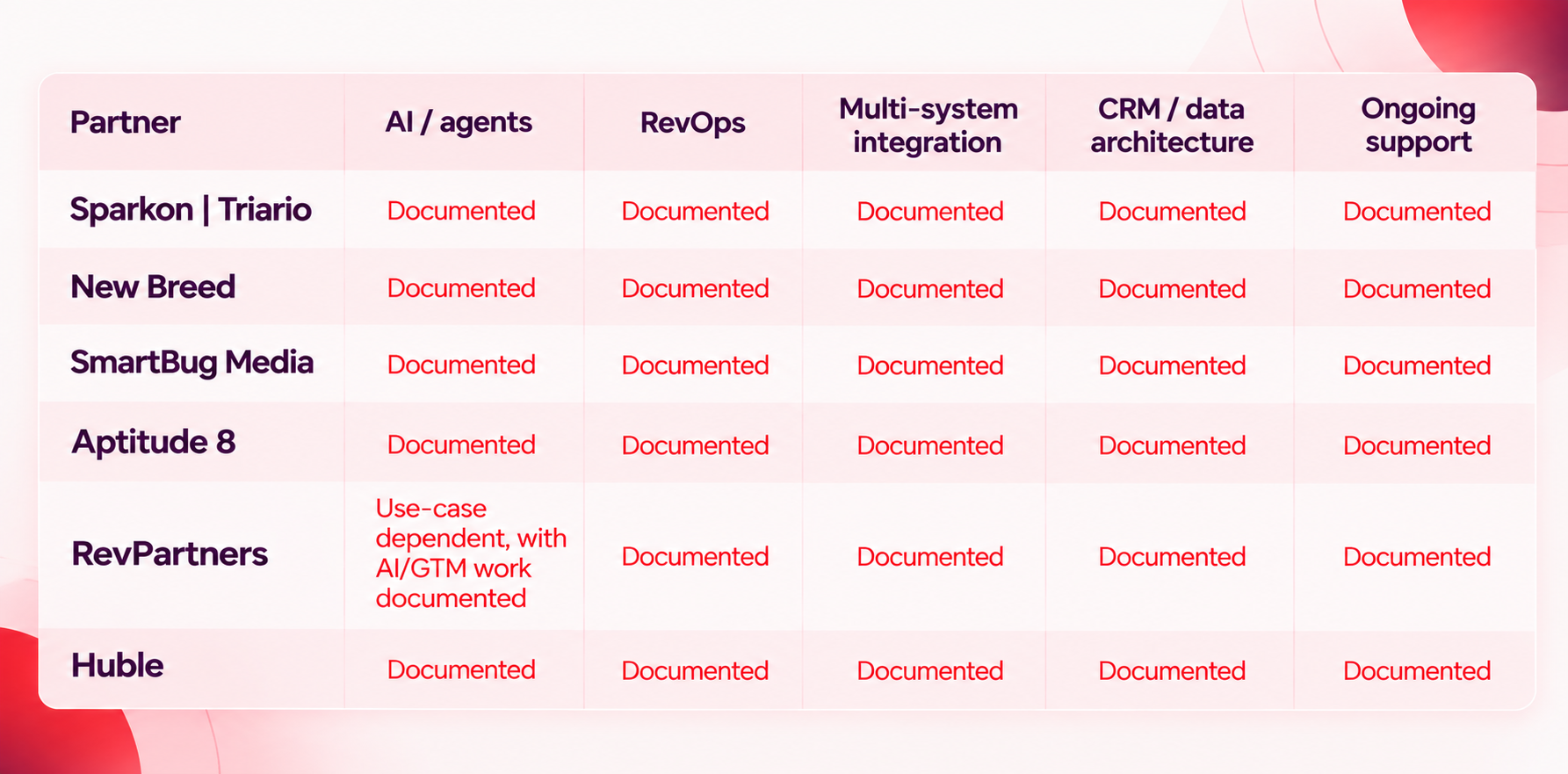
“Documented” means we identified current primary-source evidence of the capability or offering. It does not mean the six providers have equivalent depth, staffing, methodology, or customer results.
1. Sparkon | Triario: integrated RevOps, AI, and growth-system architecture
HubSpot currently lists Sparkon and Triario as two brands of one global Elite Solutions Partner group, with Sparkon serving North America and Triario serving Latin America.
The group publicly combines CRM implementation, RevOps, custom integrations, AI agents, process design, and ongoing optimization.
What differentiates its positioning is not simply the presence of AI services. Sparkon | Triario frames CRM, data, Marketing, Sales, Service, integrations, automation, and AI as parts of a single growth system.
Its published RevOps methodology begins with operational diagnosis, including current-state process mapping, gap analysis, future-state design, CRM auditing, and AI and automation readiness.
From there, the work can extend into data governance, property and lifecycle architecture, workflow design, reporting, integrations, and AI-enabled processes.
Sparkon | Triario documented capabilities
-
RevOps and process architecture: The published approach includes current-state and future-state process work across revenue teams.
Learn more about our RevOps methodology
-
CRM and data governance: Its methodology addresses areas such as CRM auditing, property governance, lifecycle definitions, naming conventions, and data hygiene.
-
Advanced HubSpot implementations: Sparkon | Triario documents work for complex environments involving multiple teams, business processes, and connected systems.
-
Custom integrations: Its integration offering includes custom API work and connections between HubSpot and external business platforms.
Find out about our custom HubSpot integrations
-
Custom AI agents: Published use cases include lead qualification, follow-up, scheduling, research, operational workflows, and CRM actions.
Read more about our custom AI agents
-
Ongoing optimization: The RevOps model is structured as an operating approach rather than a one-time portal configuration.
HubSpot's current directory also displays Partner of the Year 2023 recognition for Sparkon | Triario, along with industry specialization badges including financial services, construction, and healthcare.
Best fit
Sparkon | Triario is especially relevant to B2B organizations where the challenge extends beyond activating a specific HubSpot feature and into connecting Marketing, Sales, Service, Data + AI, and external systems.
Its cross-Americas structure can also be relevant to U.S. companies operating in Latin America or Latin American companies expanding into North America.
What to validate
Ask for customer references that resemble your operating environment, the proposed implementation team, security requirements, support SLAs, and quantified results for the specific AI or RevOps use case you want to deploy.
2. New Breed: HubSpot AI activation, RevOps, and custom integrations
New Breed is a HubSpot Elite Solutions Partner with public offerings across CRM, RevOps, demand generation, AI, AEO, and custom integrations.
Its AI practice is particularly relevant for organizations looking to activate HubSpot's native AI capabilities while also evaluating custom AI use cases.
New Breed publicly describes work with Breeze, Buying Intent, AI-powered workflows and sequences, as well as custom agents and integrations with external AI platforms.
New Breed documented capabilities
-
HubSpot AI activation: New Breed works with HubSpot-native AI capabilities, including Breeze-related use cases and AI-supported revenue workflows.
-
Custom AI: Its public offering includes specialized agents, external LLM connections, complex data actions, and cross-system workflows.
-
RevOps: The company works across CRM architecture, process alignment, and revenue operations.
-
Custom integrations: New Breed documents integrations involving systems such as ERPs, data warehouses, Salesforce, and other business platforms.
-
AEO: It also provides answer-engine optimization services focused on AI-search visibility, monitoring, and content optimization.
AEO should not be interpreted as a guarantee of citations or visibility. Search and AI platforms ultimately control which sources they surface.
Best fit
New Breed is worth evaluating when the priority is HubSpot-native AI adoption combined with RevOps, integrations, demand generation, and AI-search visibility.
What to validate
Ask which parts of the proposed architecture will run natively inside HubSpot, which require custom development or external models, how ongoing AI performance will be evaluated, and which customer cases are most comparable to your intended use case.
3. SmartBug Media: broad HubSpot, lifecycle, RevOps, and AI execution
SmartBug Media has a broader service model than a purely technical CRM consultancy. Its current HubSpot positioning spans CRM, Revenue Operations, integrations, inbound and demand generation, paid media, web, and AI.
HubSpot also named SmartBug its 2025 North America Partner of the Year. That breadth matters because the original question for some companies is not only “who can architect the CRM?” but also “who can operate more of the customer lifecycle around it?”
SmartBug documented capabilities
-
CRM and RevOps: Its current HubSpot profile documents CRM implementation and revenue-operations capabilities.
-
AI and agents: SmartBug's current offering includes Breeze AI and custom-agent deployment.
-
System integrations: Public materials describe integration work, including connections between HubSpot and other enterprise platforms.
-
Marketing execution: SmartBug continues to offer inbound, content, demand generation, paid media, and web capabilities.
-
Expanded technical capacity: Its broader ecosystem includes software and AI capabilities in addition to the traditional agency model.
SmartBug also reports having worked with more than 500 clients. That is a company-reported figure rather than an independently audited customer count.
Best fit
SmartBug is especially relevant to organizations looking for HubSpot, RevOps, technical integration, AI, and broad marketing execution under a relatively comprehensive agency relationship.
What to validate
For complex AI or integration projects, ask who owns the solution architecture, what team performs the custom engineering, and what comparable technical implementations the proposed team has delivered.
4. Aptitude 8: technical CRM architecture, development, and applied AI
Aptitude 8 has one of the most technically focused public propositions in this shortlist. Its work centers on CRM architecture, system integration, custom development, extensibility, RevOps, and advanced HubSpot implementation.
The company also now maintains a dedicated AI services offering, making older descriptions of Aptitude 8 as lacking an AI practice outdated.
Aptitude 8 documented capabilities
-
Custom CRM development: Aptitude 8 works with custom-coded workflow actions, CRM extensions, cards, middleware, portals, and other technical HubSpot capabilities.
-
Advanced integration: It documents integrations involving data platforms and data warehouses such as Snowflake and BigQuery.
-
CRM and data architecture: Complex object models, operational architecture, and extensibility are central to its positioning.
-
AI Services for GTM: Its current AI offering includes discovery, workflow design, agent deployment, enablement, governance, measurement, and ongoing services.
-
RevOps support: Aptitude 8 also provides ongoing CRM and operational support after implementation.
Aptitude 8 states that it ranked #2 globally in HubSpot's 2024 Partner of the Year standings. Because that exact ordinal claim originates from Aptitude 8's own materials, it is best presented with attribution rather than as independently verified ranking data.
Best fit
Aptitude 8 is particularly relevant when technical architecture, custom development, data movement, CRM extensibility, and integration complexity are central to the project.
What to validate
If your engagement also requires significant content, demand generation, or full-funnel marketing execution, establish early whether those capabilities will be delivered by Aptitude 8, your internal team, or another partner.
5. RevPartners: RevOps and HubSpot + Clay GTM engineering
RevPartners occupies a distinct position for companies building GTM systems around both HubSpot and Clay. HubSpot and Clay publicly identify RevPartners with Elite standing across their respective ecosystems.
Its proposition combines RevOps, CRM architecture, enrichment, GTM engineering, and ongoing operational support.
RevPartners documented capabilities
-
Fractional RevOps: RevPartners provides embedded RevOps support designed to operate as an extension of the client's team.
-
HubSpot + Clay: Clay is a prominent part of its GTM engineering proposition, especially for enrichment and outbound workflows.
-
CRM architecture: Its public services include HubSpot implementation, migration, pipeline architecture, and optimization.
-
Integrations: RevPartners documents custom, native, and low-code integrations involving systems beyond HubSpot and Clay, including platforms such as Salesforce, QuickBooks, Stripe, NetSuite, and Intercom.
-
Revenue Performance Model: Its operating framework evaluates GTM performance across acquisition, retention, and expansion.
RevPartners reports more than 1,000 CRM and RevOps implementations. That is a company-reported metric and should be treated separately from ratings displayed in HubSpot's marketplace.
There is also a recent organizational development buyers may want to discuss during procurement: Walker Sands announced its acquisition of RevPartners in June 2026, while stating that RevPartners would continue operating under its existing name.
Best fit
RevPartners is particularly relevant for B2B teams where RevOps, GTM engineering, HubSpot, Clay, enrichment, and ongoing operating support are closely connected.
What to validate
Ask how the delivery organization is structured following the acquisition and whether your intended AI scope requires custom-agent engineering beyond the HubSpot- and Clay-oriented capabilities documented publicly.
6. Huble: enterprise and multi-region HubSpot transformation
Huble replaces Lynton in this 2026 shortlist. Lynton publicly states that it stopped selling new HubSpot implementations in 2025 and left the HubSpot ecosystem. Its integration expertise remains relevant, but including it as a current HubSpot partner in a 2026 list would be inaccurate.
Huble, by contrast, remains a HubSpot Elite Solutions Partner and has a U.S. presence in Chicago. HubSpot's directory also displays Huble's 2024 Global Partner of the Year recognition.
Huble documented capabilities
-
Enterprise HubSpot implementation: Huble works across CRM implementation, migrations, automation, sales, marketing, service, and transformation initiatives.
-
Custom integrations: Its offering includes API and multi-system integration work.
-
AI readiness: Huble publishes an AI-readiness methodology involving data and systems auditing, governance, integrations, AI deployment, and ongoing optimization.
-
Multi-system AI implementation: Huble has published a case involving HubSpot, Make, Vapi, and n8n in an AI-supported lead-qualification workflow.
In that implementation, HubSpot form data entered an automated process, AI calling was used as part of qualification, structured call data passed through n8n, and resulting information was returned to HubSpot.
That type of case is useful because it demonstrates something more specific than a generic claim to “do AI”: it shows an AI use case operating across several connected systems.
Best fit
Huble is particularly relevant for enterprise, multi-region, or internationally distributed organizations where HubSpot needs to coexist with a larger technology and governance environment.
What to validate
Ask which team will serve the U.S. account, where delivery resources will be located, how governance and security will be managed, and which customer references most closely resemble your geographic and technical complexity.

How to choose the right HubSpot partner for AI and RevOps
Start with the operating problem, not the AI demo. If your CRM already has clear lifecycle definitions, reliable associations, controlled integrations, trusted data, and documented handoffs, your next step may be an AI activation project.
That could involve prospecting, research, lead scoring, customer support, data enrichment, or workflow automation. If the foundation is inconsistent, more automation can increase the number of processes depending on those inconsistencies.
Before selecting a partner, ask every finalist the same questions.
1. How will you diagnose our current state?
A serious assessment should look beyond enabled HubSpot features. Ask how the partner evaluates:
- objects and properties
- associations
- lifecycle definitions
- pipelines
- workflows
- permissions
- integrations
- handoffs between teams
- data ownership
- existing AI or automation dependencies
2. What actually needs to be fixed before the AI use case launches?
Not every data-quality issue blocks every AI use case. A useful partner should distinguish between true prerequisites, important improvements, and cleanup that can happen later.
3. What runs natively in HubSpot and what is custom?
Ask for a clear architecture. You should understand:
- which HubSpot capabilities are being used
- which external models or platforms are involved
- where data moves
- which system is authoritative
- who owns each component
- what happens when a dependency fails
Find out more about our HubSpot integration architecture
4. Where does a human stay in the loop?
AI autonomy should be designed according to the consequences of an error. Ask who reviews or approves actions related to:
- customer communication
- pricing
- qualification
- sensitive data
- pipeline changes
- service escalation
- high-value accounts
5. How are integrations operated after launch?
The architecture is only part of the problem. Ask who owns monitoring, logging, error handling, maintenance, API changes, and future updates.
6. How will success be measured?
An AI project should have more than an adoption metric. Ask the partner to define:
- baseline performance
- operational KPI
- business KPI
- test period
- quality threshold
- review cadence
- conditions for iteration, escalation, or shutdown
Why Sparkon | Triario stands out for integrated growth systems
The real differentiator is not access to AI. It’s the operating system built around it.
The most defensible way to differentiate Sparkon | Triario is not to claim that other HubSpot partners lack AI. They do not. New Breed, SmartBug, Aptitude 8, RevPartners, and Huble all have current evidence of AI, automation, integration, or data capabilities relevant to this comparison. The distinction is the operating model.
Sparkon | Triario positions growth as a connected system where Marketing, Sales, Service, and Data + AI share processes, architecture, and governance rather than functioning as separate transformation projects.
Its published RevOps methodology begins with understanding how the organization works today, identifying gaps, designing the future state, and evaluating CRM and AI readiness. That foundation can then support implementation work across CRM structure, integrations, governance, automation, reporting, and custom agents.
For organizations whose HubSpot challenge is larger than one Hub or one AI feature, that system-level approach is worth evaluating alongside the other partners in this list.
FAQs about AI-first HubSpot partners
What makes a HubSpot partner AI-first?
“AI-first” is not an official HubSpot Solutions Partner designation in this article. We use the term for partners that demonstrate the ability to connect AI use cases with the CRM data, architecture, integrations, governance, processes, and ongoing operations those use cases depend on.
Does poor CRM data affect AI readiness?
At a general level, yes. HubSpot connects data quality with CRM reliability, reporting, and AI-tool performance, while current research on agentic AI emphasizes the importance of data, business context, governance, and trust.
That does not mean every data issue affects every AI system in the same way.
Do duplicate records cause HubSpot predictive scoring to average data from different contacts?
We found no support for that mechanism.
HubSpot treats duplicates as a data-quality problem and provides tools to consolidate duplicate records, activities, associations, and properties. Its predictive scoring documentation does not say that duplicate contacts are mathematically “averaged” together.
Can these partners integrate HubSpot with an ERP, data warehouse, or other systems?
All six partners in this shortlist have current public evidence of integration capability, although the technical depth, delivery model, supported platforms, and ongoing support structure vary.
Buyers should evaluate the architecture required for their specific stack rather than treating “integrations” as a single capability.
How long does an AI-ready HubSpot implementation take?
There is no defensible universal timeline. The answer depends on factors such as:
- existing CRM condition
- migration requirements
- number of Hubs
- number and complexity of integrations
- custom development
- data volume and quality
- security and governance
- process redesign
- change management
- AI use-case scope
Compare implementation plans, assumptions, dependencies, and acceptance criteria instead of relying on a generic duration.
Can a partner help if we already have HubSpot running?
Yes. Many AI and RevOps projects begin with an existing portal rather than a new implementation. The work may involve CRM auditing, lifecycle redesign, data cleanup, integration changes, reporting, governance, workflow redesign, or new AI use cases built on top of the current environment.
Is AEO important when choosing a HubSpot partner?
It depends on your growth strategy. If AI-assisted discovery and answer engines influence how your buyers research vendors, AEO can be worth measuring. But it should not be treated as a guaranteed ranking or citation mechanism. Strong technical SEO, crawlability, useful original content, credible evidence, and clear topical relevance remain foundational.
Build the architecture before you scale the automation
AI can add new capabilities to a HubSpot environment, but it does not remove the need to understand the system underneath it. If Marketing, Sales, Service, data, and external platforms are operating with different rules, the first step may be understanding how those pieces fit together.
Sparkon | Triario's published approach combines process analysis, CRM and data governance, integrations, automation, and AI-agent deployment within a broader RevOps framework.
Talk to Sparkon | Triario about your RevOps and AI readiness and identify the architecture, governance, and implementation priorities for your next stage of growth.